Hair Restoration · Beard Transplant
Beard transplant in Berlin – filling beard gaps with your own hair
A natural-looking beard is not created by transplanting as many hairs as possible. What matters is the right distribution, suitable spacing, and the angle and direction of growth of every single graft in its particular beard zone.
In a beard transplant at AS Clinic Berlin on Kurfürstendamm, suitable hair follicles are taken from a donor area and placed into patchy or sparsely grown parts of the beard. Depending on the starting point, the planning can include the cheeks, jawline, sideburns, moustache or chin.
At visible contours in particular, fine single-hair grafts are used so that the transition looks soft and natural. In the denser body of the beard, suitable multi-hair follicular units can also be considered, depending on the anatomy and the result you want.
A beard transplant is not a method that creates new hair follicles. It moves existing follicles of your own from a suitable donor area into the planned recipient region.
What is a beard transplant?
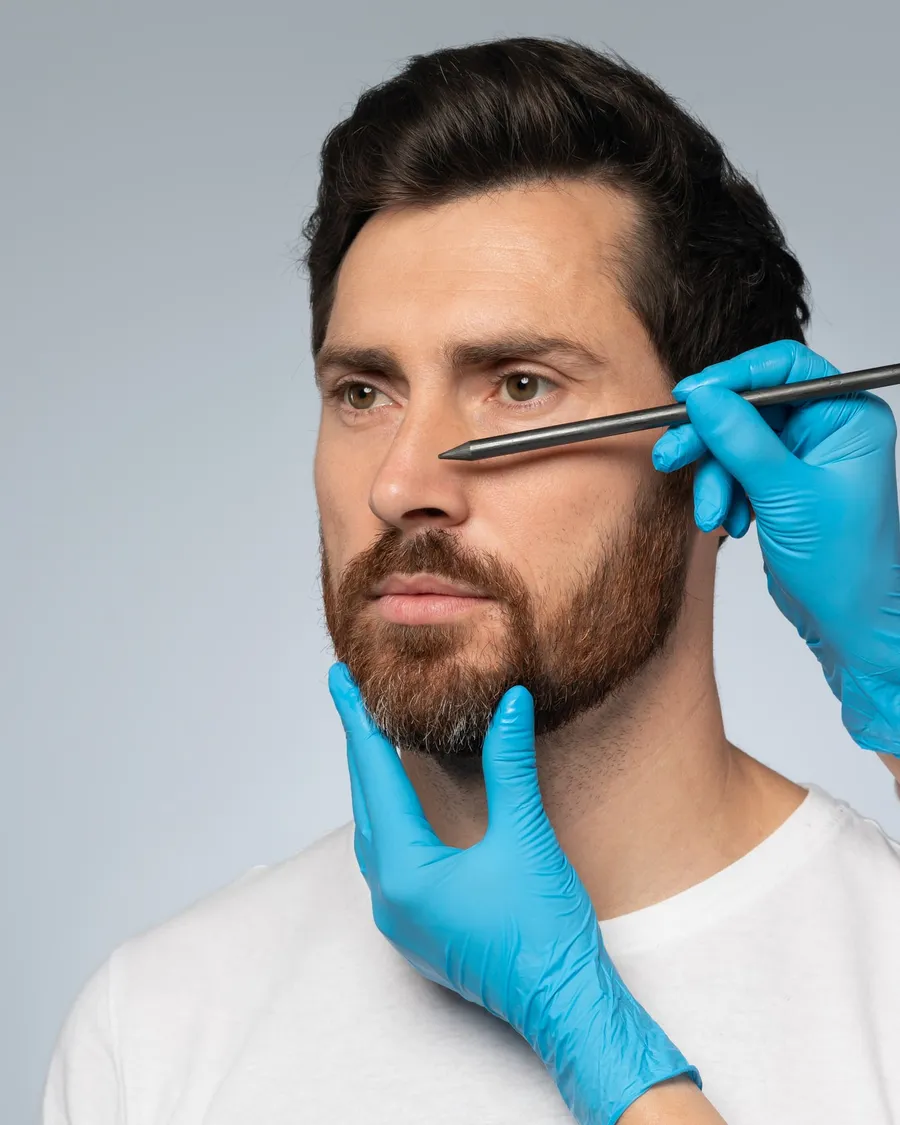
A beard transplant is a transplant of your own hair in the face. Suitable hair follicles are taken from a donor area and transplanted into planned beard areas to fill in permanently patchy or sparsely grown regions. The follicles are not simply distributed evenly: every beard zone has its own natural direction of growth and its own angle, and the implantation has to respect that anatomy so the beard later looks like natural beard growth rather than an even field of hair. The typical beard regions are the sideburns, the cheek beard, the jawline, the area under the jaw, the chin and goatee, and the moustache with its transition to the chin.
Beard transplant in Berlin – the key facts at a glance
- Treatment
- Hair transplantation of your own hair for the beard area
- Technique
- FUE-based extraction; implantation according to beard zone, angle and direction of growth
- Possible areas
- Cheeks, jawline, sideburns, chin, goatee and moustache
- Natural result
- Contours with fine single-hair grafts; density planned per zone
- Donor hair
- Individually selected scalp hair, matched as closely as possible
- Location
- AS Clinic, Kurfürstendamm 102, 10711 Berlin-Charlottenburg
- Anaesthesia
- Local anaesthesia
- Recovery
- Crusts, redness, tenderness or swelling are possible
- New growth
- Often from about 3–4 months
- Final result
- Develops over several months; judging it early is not meaningful
- Number of grafts
- Depends on the area, the existing beard density and the design you want
- Consultation
- Individual beard and donor-hair analysis before the procedure
What can a beard transplant be used for?
A beard transplant may be an option where beard areas are permanently patchy, genetically weak or sparse after stable scarring or injury, and enough suitable donor hair is available. Where beard loss is new, patchy, inflammatory or medically unexplained, the cause should be investigated before an aesthetic transplant. Possible starting points are:
- Naturally patchy or very weak beard growth
- Uneven density between the right and left side of the face
- A missing connection between the moustache, cheek and chin
- Sparse sideburns or cheek areas
- Stable hairless scars after injuries, surgery or acne, where the tissue is suitable
- Reconstruction of a wanted beard shape where hair is permanently missing
More on this: Hair restoration in Berlin
What makes a beard transplant look natural?
For a natural result it is not only the number of grafts that matters, but above all the hair angle, the direction of growth, the type of graft, the spacing and the transitions between beard zones. Planning takes into account, among other things:
- The existing natural direction of beard growth
- The shape of the face and the jaw contour
- The transition between sideburns, cheek and jawline
- Density in the body of the beard
- A soft rather than hard contour at the beard borders
- The thickness and structure of the donor hair
- Natural differences between the two sides of the face
- The beard length you want – from stubble to a full beard
Why do the angle and direction of growth matter so much in a beard?
Beard follicles grow in different directions in each region of the face. Transplanted hairs should therefore be placed at an angle suited to the particular zone — usually flat to acute — and parallel to the natural movement of the beard. On the cheeks and sideburns the hairs often run laterally and downwards; along the jawline, chin and moustache the orientation changes again. A single uniform angle across the whole face would therefore look unnatural. Precise orientation matters particularly if the beard is to be worn short or as stubble: at short hair lengths, the direction of growth, the spacing and individual misaligned hairs are far more visible.
A beard transplant for natural-looking stubble
Anyone wanting to wear the beard very short needs particularly precise planning of density and direction. With stubble, longer hairs do not cover irregularities; the spacing, angle and distribution of the grafts stay visible. Density is therefore not planned identically everywhere: contours benefit from finer transitions and predominantly single hairs, while a different distribution can make sense in the body of the beard.
Why do the beard contours need single-hair grafts?
Single-hair grafts allow a softer, more natural beard border. Larger follicular units placed directly at a visible contour can create an impression that is too hard or tufted. In the inner body of the beard, suitable single- and multi-hair follicular units can be combined to achieve sufficient visual density. Which grafts are used depends on the beard zone and the donor hair.
Where does the hair for a beard transplant come from?
Suitable scalp hair is often used as the donor hair. The donor area is chosen so that the hair thickness, structure and available follicular units match the planned beard as closely as possible. For many people the back of the head can provide suitable follicles, but for a beard reconstruction not every follicle is equally valuable: the visible contours in particular need fine single-hair grafts, while follicular units with more hairs can be used in the body of the beard where they fit.
Does transplanted scalp hair keep its characteristics?
Transplanted hair follicles keep the essential characteristics of their donor area. That means the growth rate, maximum hair length and structure can differ from natural beard hair. Anyone wearing the beard very short can trim the transplanted hairs accordingly; with longer beard styles the difference is perceived differently depending on your individual hair structure.
FUE or DHI for a beard transplant – what actually matters?
FUE describes extracting the hair follicles individually. DHI often refers to implantation with an implanter system. For a natural beard result, however, what matters above all is suitable grafts, precise planning of the recipient sites and the correct angle and direction. Depending on the treatment plan, recipient sites can be prepared before implantation or implanter techniques can be used. The name of the method alone guarantees no better result.
How is the beard shape planned?
The beard shape is not set to a fixed template. The shape of the face, the existing beard growth, the jawline, the beard length you want and the amount of suitable donor hair together determine the design. Before treatment we can establish:
- How high the cheek line should run
- How the sideburns blend into the beard
- How wide the goatee and chin area should be
- Whether the moustache and chin should be connected
- How strongly the jawline should be emphasised
- Which areas should deliberately stay less dense so the pattern looks natural
Can a beard transplant even out asymmetries?
Slight differences between the right and left side of the beard can be taken into account during planning. Complete mathematical symmetry is neither always achievable nor necessary for a natural beard. The two halves of a face naturally differ in bone shape, skin, existing beard density and direction of growth, so a transplant aims at a harmonious balance rather than an artificially identical distribution.
Beard transplants into scars
A beard transplant into stable, fully healed scars can be possible in principle. Scar tissue differs from normal skin in its blood supply and structure, however, so graft survival and the density needed have to be assessed individually. With scars after acne, injuries or surgery we check whether the tissue is stable and a transplant appears sensible. Active inflammation or undiagnosed skin conditions should be treated or diagnosed first.
Beard transplants with patchy or sudden beard loss
Bald patches that appear suddenly should not be transplanted as a matter of course. Patchy hair loss can have medical causes such as alopecia areata and should be assessed and stabilised medically before a surgical procedure. A transplant does not treat the underlying activity of a hair condition, so operating into an active condition can be unsuitable.
How many grafts do you need for a beard transplant?
The number of grafts needed is individual. It depends on whether individual gaps, the cheeks, sideburns, moustache, goatee or a larger beard area are being treated, and how much natural beard is already there. Sound planning is therefore based on the actual area and the available donor hair – not on a blanket number of grafts for everyone. Further factors are:
- The size of the area to be treated
- The density you want
- The beard style you want
- The existing beard density
- The quality and structure of the donor hair
- The proportion of suitable single-hair grafts
- Scar tissue or other particularities
How a beard transplant works at AS Clinic Berlin
-
Consultation and beard analysis
We start by discussing which beard areas you would like to change, whether individual gaps or a larger area are to be treated, and which beard style you want to wear afterwards.
-
Planning the beard contour
The planned areas are set out using the face, the jawline, the existing beard growth and the shape you want. Visible contours and transitions are planned particularly conservatively.
-
Analysis of the donor area
The donor area is assessed for density, hair thickness, follicle structure and the availability of single-hair grafts. The aim is to obtain the hairs needed without putting unnecessary strain on the donor area.
-
Local anaesthesia
The donor and recipient regions are anaesthetised locally. General anaesthesia is not usually required for a classic FUE beard transplant.
-
FUE-based extraction
The follicular units needed are extracted individually. The grafts are then selected according to their suitability for contour or beard body and prepared for implantation.
-
Planning the recipient sites by beard zone
The recipient sites are created at angles and in directions suited to the particular beard region, paying close attention to the natural orientation of the hairs already there.
-
Implanting the grafts
At visible contours, fine single-hair grafts are preferred. In the body of the beard, further suitable follicular units can be placed depending on the density wanted and the grafts available.
-
Aftercare and growth phase
Small crusts form around the transplanted grafts after the procedure and the fresh recipient sites have to be protected at first. The actual new growth only begins after a resting phase.
How does healing after a beard transplant go?
In the first days, redness, small crusts, tenderness and swelling can occur. The transplanted grafts have to be handled particularly carefully during the early healing phase. You receive the specific washing, care and shaving instructions after the procedure; crusts should not be picked off early.
Do the transplanted beard hairs fall out at first?
Yes. A temporary shedding of the transplanted hair shafts in the first weeks is common after hair transplants. The follicles remain in the skin and can produce new hairs after a resting phase. This shedding process does not automatically mean the grafts are lost.
When does the transplanted beard grow?
New hair growth often begins from about the third to fourth month. Density then continues to develop step by step, because not all transplanted follicles enter the new growth phase at the same time. Judging the result after a few weeks is therefore too early.
When do you see the final result?
Beard density develops over several months. A clearer assessment is often possible after about six to eight months; further maturation and development of density can continue to roughly the end of the first year. Whether a later densification makes sense should only be decided once enough growing time has passed.
When can you shave the transplanted beard?
In the early healing phase the recipient region should not be stressed by shaving or strong mechanical contact. When shaving or trimming is possible again is cleared individually, based on how healing progresses. Once healing is complete, the transplanted hairs can generally be cut and shaved like other beard hairs.
Is a beard transplant permanent?
Transplanted hair follicles that have taken successfully can keep growing long term. A hundred per cent survival rate or unchanged density cannot be guaranteed, however. The long-term appearance depends among other things on graft survival, the characteristics of the donor hair, ageing, any skin or hair conditions and your individual beard design.
Risks and possible side effects
A beard transplant is a surgical procedure and not entirely free of risk. Common temporary reactions are redness, crusting, swelling, tenderness and small bruises. The face has a good blood supply, so careful technique, suitable graft selection and precise planning of the recipient sites are important parts of the treatment. Possible risks and complications include:
- Redness, crusting and swelling
- Tenderness or pain
- Small bleeding or bruising
- Infection or folliculitis
- Temporary changes in sensation
- Insufficient growth of individual grafts
- Uneven density
- An unwanted direction of growth or unsuitable hair angle
- Visible irregularities in the recipient area
- Small pinpoint scars in the FUE donor area
- Temporary shock loss of existing hairs in some cases
Which symptoms after the procedure should be assessed?
Severe or increasingly unusual pain, pronounced redness, pus, fever, marked one-sided swelling or other unexpected symptoms should be assessed medically promptly.
Who may a beard transplant be suitable for?
A beard transplant may be an option for adults where beard areas are permanently patchy or hairless, enough suitable donor hair is available and no active condition in the recipient area speaks against a procedure. Among the things taken into account are:
- The cause and duration of the missing beard growth
- The existing beard density and direction of growth
- The condition of the skin and any scarring
- The quality and density of the donor hair
- Previous hair or beard transplants
- Pre-existing conditions and medication
- The beard style you want and realistic expectations
When should a beard transplant not be carried out, or only later?
With active skin infections, inflammatory conditions or unstable or unexplained hair loss in the beard area, a procedure can be unsuitable or postponed. Certain illnesses, clotting problems, medicines or other individual risk factors can also speak against an immediate procedure. Prescribed medicines should never be stopped or paused on your own initiative for a transplant.
Beard transplant on Kurfürstendamm in Berlin-Charlottenburg
AS Clinic Berlin is located on Kurfürstendamm in Berlin-Charlottenburg. If you are looking for a beard transplant in Berlin, an FUE beard transplant, beard densification or a treatment for permanently patchy beard growth, your individual starting point is assessed first.
AS ClinicKurfürstendamm 102
10711 Berlin · Charlottenburg
+49 179 390 2489
Mon – Fri · 10:00 – 19:00
Saturday · 10:00 – 16:00
Sunday · Closed
More on this: AS Clinic Berlin on Kurfürstendamm — location and directions
Why choose AS Clinic for a beard transplant in Berlin?
Beard design based on your face and existing growth
The planned beard shape is not set to a universal template. The shape of the face, the jawline, the existing beard growth and the beard length you want are all considered together.
Fine grafts for natural contours
At visible beard borders, fine single-hair grafts are preferred to achieve a soft transition. Density in the body of the beard is planned separately.
Angle and direction for every beard zone
The sideburns, cheek, jawline, moustache and chin all have different directions of growth. The implantation is oriented to the particular region.
Donor hair chosen for more than quantity
Hair thickness, structure and the availability of suitable single-hair follicles are also taken into account. A natural beard needs more than a high raw graft count.
Realistic information about growth
Shedding, the slow start of growth and the months-long development of density are all covered in advance. We do not promise a fully visible beard immediately after the procedure.
Medical qualification
Nader Farahwaschy – specialist in surgery. Medical licence since 2004; specialist recognition in surgery from the Berlin Medical Association since 2011.
Questions
Frequently asked questions about beard transplants in Berlin
Twenty answers written by our physicians.
What is a beard transplant?
Which method is used for a beard transplant?
Can a patchy beard be filled in?
Can a completely new beard be transplanted?
Can only the cheeks be transplanted?
Can a moustache be transplanted?
How many grafts do you need for a beard?
Where does the hair for the beard come from?
Do transplanted beard hairs look natural?
Why are single hairs used at the contour?
Is FUE or DHI better for the beard?
How important is the angle in a beard transplant?
Can a beard transplant look like stubble?
Do the transplanted beard hairs fall out after the procedure?
When does the transplanted beard grow?
When do you see the final result?
Is a beard transplant permanent?
Do transplanted beard hairs have to be trimmed?
When can you shave after a beard transplant?
Can scars in the beard area be transplanted?
Does a beard transplant help with alopecia areata?
Can a beard transplant even out asymmetries?
Does a beard transplant hurt?
How long is the downtime?
What are the risks of a beard transplant?
What does a beard transplant cost at AS Clinic Berlin?
Where can I have a beard transplant in Berlin?
Related treatments at AS Clinic Berlin
Eyebrow Transplant
Eyebrow transplant in Berlin: the same single-hair principle, planned for the brow.
PRP Meso Hair
PRP and hair mesotherapy in Berlin: supporting treatments around a transplant.
Hair Meso
Hair mesotherapy in Berlin: micro-injections for the scalp and hair.
Jawline Filler
Jawline filler in Berlin: defines the jaw structurally, where hair is not the issue.
Botox
Botox in Berlin: treats muscle activity in the face.
Skin Booster
Skin Booster in Berlin: injectable hydration for skin quality.
Appointments
Arrange a beard transplant consultation in Berlin
Do you have permanently patchy beard growth, would you like to densify individual areas or plan a new beard contour? Arrange a personal consultation at AS Clinic Berlin on Kurfürstendamm. We discuss your existing beard growth, your face and jawline, the beard shape you want, the donor hair, the possible graft requirement, the direction of growth, the risks and the realistic timeline.