Hair · FUE transplantation
Hair transplant in Berlin – follicular unit extraction at AS Clinic
A hair transplant moves your own hair follicles from a donor zone that is genetically resistant to hormonal thinning into the areas where hair has become sparse. At AS Clinic Berlin on Kurfürstendamm this is done by follicular unit extraction (FUE): follicle by follicle, punch by punch, without a linear scar.
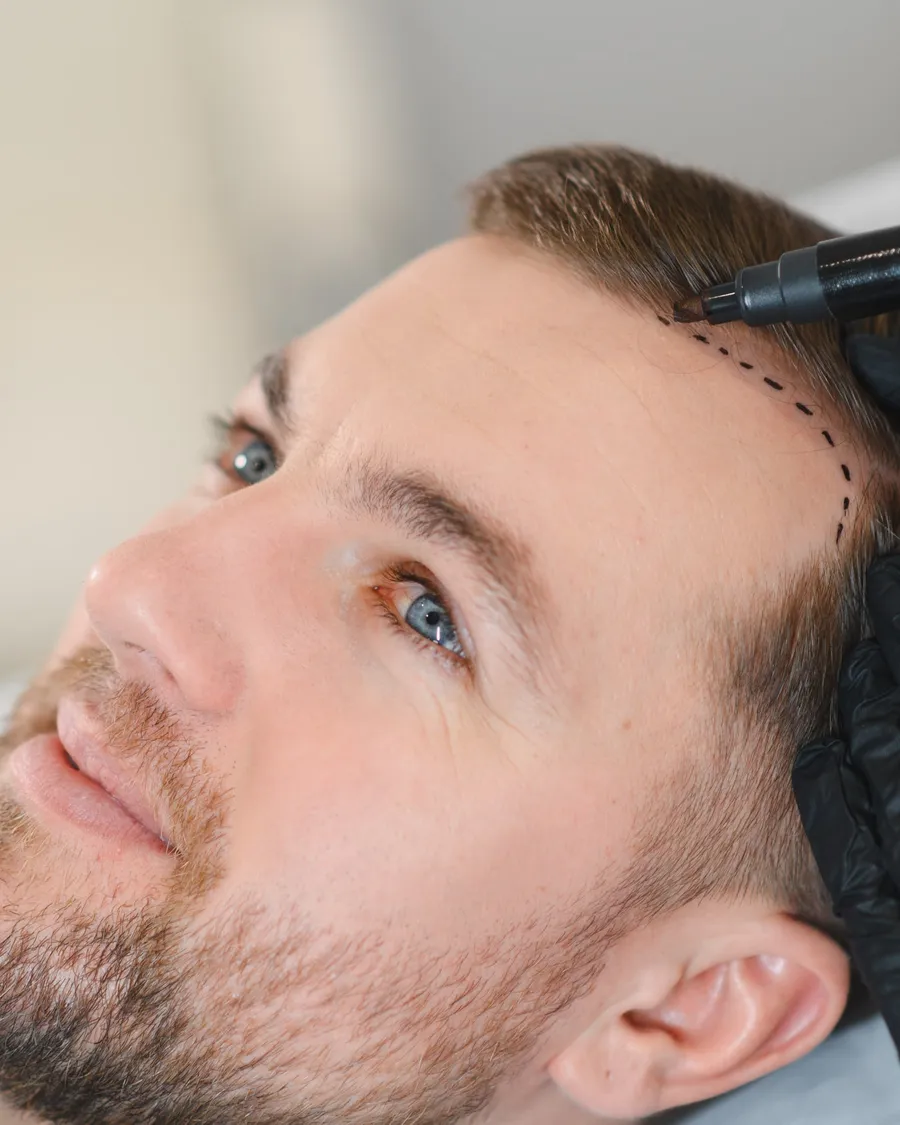
What decides whether a result looks natural is not the number of grafts alone. It is where the hairline is drawn, at which angle and direction each follicle is placed, and how single-hair and multi-hair grafts are distributed between the front row and the zones behind it.
Just as important is what a transplant cannot do: it does not stop your own pattern of loss. The native hair around the transplanted area continues to follow its own course, which is why the donor zone, your age and the likely progression of thinning are assessed before any graft number is agreed.
What is a hair transplant?
A hair transplant is a procedure in which your own hair follicles are taken from a donor zone — usually the back and sides of the head — and placed into thinning or bald areas. At AS Clinic the extraction is done by FUE, meaning each follicular unit is removed individually with a fine punch rather than as a strip of skin. The transplanted follicles keep the properties of the donor zone, so they behave like donor hair for life; the surrounding native hair does not.
Hair transplant in Berlin – the key facts at a glance
- Technique
- Follicular unit extraction (FUE), punch by punch
- Typical graft count
- 1,800–2,500 for a receding hairline; 3,000–4,500 for a full crown restoration
- Determining your number
- Trichoscopy and graft count at the consultation
- Anaesthesia
- Local anaesthetic — you stay awake
- Length of the day
- About six to nine hours including breaks and lunch, depending on graft count
- Scarring
- Hundreds of punctate healing points under 1 mm; no linear scar
- Back to office work
- Often from day 3–4 with a loose cap
- Growth timeline
- Shedding weeks 2–6, first growth month 3–4, meaningful density month 8, final result month 12–15
- Aftercare included
- PRP and Hair Meso support for 12 months
- Density audit
- Reviewed at month 12; a shortfall against the agreed plan is corrected at no cost
- Location
- AS Clinic, Kurfürstendamm 102, 10711 Berlin-Charlottenburg
FUE or FUT – which technique is used?
AS Clinic works with follicular unit extraction. Each follicular unit is removed individually with a fine punch instead of a strip of skin being cut from the back of the head. That leaves no linear scar and lets you keep your hair short afterwards. What FUE requires in return is patience: the extraction of several thousand units is the part of the day that takes the longest.
- No linear donor scar — short haircuts stay possible
- Healing points under 1 mm, invisible from conversational distance within about a month
- Diffuse extraction, so donor density drops evenly rather than in a patch
- The number that can be taken safely is limited by your donor zone, not by your wishes
More on this: Hair treatments in Berlin
How many grafts will I need?
The honest answer only exists after trichoscopy. As a guide, a receding hairline is typically 1,800–2,500 grafts and a full crown restoration 3,000–4,500. What that number has to cover is decided together with you, because the donor zone is a finite resource that also has to serve any future session.
- Density of the donor zone and hair thickness per follicular unit
- Size of the area to be covered and the contrast between hair and scalp
- How far the loss is likely to progress in the coming years
- Whether the front hairline, the crown or both are the priority
- Whether a second session should be kept in reserve
How is a natural hairline designed?
A hairline is drawn to your facial proportions and to how your forehead actually moves, not to a template or to the hairline you had at twenty. It is deliberately placed where it will still look plausible in fifteen years. Single hairs go into the front row and multi-hair grafts behind them, so the transition is soft rather than a hard line. A slight irregularity is part of the design: a perfectly straight hairline reads as artificial.
- Facial proportions and forehead movement decide the height
- Single-hair grafts in the front row, multi-hair grafts behind
- Angle and direction of growth follow the existing hair
- Temple recessions are shaped rather than filled in completely
- Age and expected progression are built into the design
Am I too young for a hair transplant?
Under 25 the loss is usually stabilised medically first and transplanted afterwards. The reason is arithmetic rather than caution: if the donor zone is spent chasing a hairline that is still moving, there may be too little left for the areas that thin later. That does not rule out a transplant at a younger age — it means the plan has to account for where the loss is heading.
More on this: Hair mesotherapy in Berlin — strengthening existing follicles
Do women have hair transplants here?
Yes — for frontal recession, a widened parting and scars after surgery. In most cases the recipient area does not have to be shaved. What matters beforehand is the cause: diffuse thinning has many possible reasons, and not all of them are treated by transplantation. Where a medical cause is likely, it is clarified first.
Hair transplant, Hair Meso or PRP – what is the difference?
Transplantation moves follicles; mesotherapy and PRP work on the follicles you still have. They address different problems, which is why they are combined rather than weighed against each other.
| Hair transplant | Hair Meso / PRP |
|---|---|
| Moves your own follicles into thinning areas | Treats the follicles already present |
| Creates density where nothing grows any more | Supports and strengthens existing hair |
| One surgical day under local anaesthetic | Several short sessions, then maintenance |
| Result over 12–15 months | Effect while treatment is continued |
| Does not stop your own pattern of loss | Does not replace a transplant where hair is gone |
More on this: PRP hair mesotherapy in Berlin
Can a previous transplant be corrected?
Often yes. Older or poorly planned work can be improved by redistributing the front row, excising visible plug grafts and adding density behind them. What such a correction needs is a longer plan and a realistic view of the remaining donor zone, because part of it has already been used.
Will I still need medication afterwards?
Usually yes, to protect the native hair around the grafts. The transplant does not stop your original pattern of loss: transplanted follicles keep the properties of the donor zone, while the surrounding hair continues to follow its own course. Which medication is appropriate, and whether it is appropriate for you at all, is a medical decision made individually — never one to start or stop on your own.
How a hair transplant works at AS Clinic Berlin
-
Consultation and trichoscopy
The scalp is examined under magnification. Donor density, hair thickness, the pattern and probable progression of loss, previous treatments, illnesses and medication are assessed — and from that comes your graft count rather than a round number quoted in advance.
-
Hairline design
The hairline is drawn to your facial proportions and forehead movement, and reviewed with you in the mirror before anything else happens. Height, temple shape and the distribution of density across the areas to be covered are agreed at this point.
-
Local anaesthetic
The donor and recipient areas are anaesthetised locally. You stay awake through the day, watching a film or sleeping; the day is long, but the procedure itself is not painful.
-
Extraction, punch by punch
The follicular units are removed individually from the donor zone in a diffuse pattern, so that the density there decreases evenly and invisibly rather than leaving a thinned patch.
-
Placement
The grafts are placed at the angle and direction of growth that match the surrounding hair: single hairs in the front row, multi-hair grafts behind. This step decides how natural the result reads far more than the graft number does.
-
Aftercare and follow-up
You leave with washing instructions and a clear plan for the first days. PRP and Hair Meso support is included for 12 months, and density is audited at month 12 against the plan agreed at the start.
What happens in the first days and weeks?
Small crusts form around each graft and fall away over roughly the first one to two weeks. Redness in the recipient area fades gradually. The donor zone is fully covered again after about two weeks. Then, between weeks 2 and 6, the transplanted hairs shed — this is expected and is not a failure of the graft: the follicle stays, the shaft is what falls out.
When can I work or exercise again?
Office work is often possible from day 3–4 with a loose cap; client-facing days are more comfortable from about day 10, once the redness has settled. For exercise: walking from day 3, light training from day 10, heavy lifting and swimming from week 4. Direct pressure, friction and sun on the fresh grafts are what should be avoided in the meantime.
When will I see the result?
The timeline is slow and it is worth knowing it in advance: shedding at weeks 2–6, first growth at month 3–4, meaningful density at month 8 and the final result at month 12–15. Judging the outcome at month 4 tells you very little — density is still building, and the hairs that have come through are finer than they will be.
Is the result permanent?
The transplanted follicles come from the donor zone, which is genetically resistant to hormonal thinning, so they behave like donor hair for life. Your native hair around them does not: it continues to follow your original pattern of loss, which is why protecting it is part of the plan rather than an afterthought.
Are there scars?
FUE leaves hundreds of punctate healing points under 1 mm rather than one line. Within about a month these are invisible from conversational distance, and short haircuts remain possible. How conspicuous they are depends on skin type, healing and how much has been extracted.
Risks and possible complications
A hair transplant is a surgical procedure and is not free of risk. Alongside the general risks of surgery, the donor zone, graft survival and the design of the result are what matter most. Possible risks include:
- Swelling of the forehead in the first days
- Redness, crusting and temporary tenderness
- Infection or folliculitis around individual grafts
- Temporary numbness or altered sensation in the donor or recipient area
- Shock loss of native hair around the grafts, usually temporary
- Visible thinning of the donor zone if too much is extracted
- Individual grafts that do not take
- An unnatural result where angle, direction or hairline design were wrong
- The need for a further session
Which symptoms should be checked afterwards?
Severe or rapidly increasing pain, spreading redness, pus, fever, marked one-sided swelling or persistent bleeding should be assessed without delay. Ordinary crusting, mild swelling and the shedding phase between weeks 2 and 6 are expected and are not warning signs.
Who is a hair transplant suitable for?
It can be an option for adults with a sufficient donor zone, a stable or medically stabilised pattern of loss and realistic expectations about coverage and timeline. Taken into account when assessing suitability:
- Donor density and hair thickness
- Extent of the area to be covered
- Age and likely progression of the loss
- Cause of the thinning, where it is not clearly hereditary
- Pre-existing conditions, medication and wound-healing risks
- Willingness to protect the native hair afterwards
- Realistic expectations of density and of the 12–15 month timeline
When might a transplant not be the right step?
Where the donor zone is insufficient for the area to be covered, where loss is advancing rapidly and has not been stabilised, or where the thinning has a cause that transplantation does not treat, another approach makes more sense. Acute scalp conditions, uncontrolled medical risks or unfavourable wound-healing conditions can postpone or rule out surgery. Prescribed medication must never be stopped or paused on your own initiative for an aesthetic procedure.
What does a hair transplant cost in Berlin?
The cost depends on the graft count, and therefore on the area to be covered and your donor density. Because the graft number comes from trichoscopy rather than from a phone call, the specific price is discussed after the personal examination and before the procedure.
Hair transplant on Kurfürstendamm in Berlin-Charlottenburg
AS Clinic Berlin is located on Kurfürstendamm in Berlin-Charlottenburg. If you are looking for a hair transplant in Berlin, an FUE procedure or a correction of earlier work, the first step is trichoscopy and an honest assessment of what your donor zone allows. AS Clinic Berlin, Kurfürstendamm 102, 10711 Berlin-Charlottenburg. Phone: +49 179 390 2489. Opening hours: Monday–Friday 10:00–19:00, Saturday 10:00–16:00, Sunday closed.
AS ClinicKurfürstendamm 102
10711 Berlin · Charlottenburg
+49 179 390 2489
Mon – Fri · 10:00 – 19:00
Saturday · 10:00 – 16:00
Sunday · Closed
More on this: AS Clinic Berlin on Kurfürstendamm — location and directions
Why choose AS Clinic for a hair transplant in Berlin?
Your graft count comes from trichoscopy
The number is measured at the consultation rather than quoted in advance. Donor density and hair thickness decide what is realistically possible — not a package.
The donor zone is treated as finite
Extraction is diffuse, and the plan accounts for the fact that a later session may still need donor hair. Taking the maximum today is not automatically the better outcome.
The hairline is drawn for the next fifteen years
Height and shape are planned to your proportions and to how the loss is likely to progress, so the result still looks plausible as you age.
Aftercare is part of the treatment
PRP and Hair Meso support is included for 12 months, because protecting the native hair around the grafts is what keeps the overall result stable.
Density is audited at month 12
The result is reviewed against the plan agreed at the start. Any shortfall is corrected in a touch-up session at no cost.
Medical qualification
Nader Farahwaschy – specialist in surgery. Medical licence since 2004; specialist recognition in surgery from the Berlin Medical Association since 2011. Individual suitability is assessed at the personal consultation.
Questions
Frequently asked questions about hair transplants in Berlin
Twenty answers written by our physicians.
What is a hair transplant?
FUE or FUT — which do you do?
How many grafts will I need?
Am I too young for a hair transplant?
Will the new hairline look natural?
How long does the day take?
Is the procedure painful?
Do I have to shave my head?
When can I go back to work?
When can I train again?
When will I see hair?
Why does the transplanted hair fall out first?
Is the result permanent?
Will I need a second session?
What happens to my donor zone?
Are there scars?
Can you fix a previous bad transplant?
Do women get hair transplants here?
Will I still need medication after surgery?
What is Hair Meso?
What is PRP hair mesotherapy?
Is aftercare included?
What if a graft does not take?
What are the risks?
Can a hair transplant treat every kind of hair loss?
Which anaesthesia is used?
What does a hair transplant cost at AS Clinic Berlin?
Where can I have a hair transplant in Berlin?
Related treatments at AS Clinic Berlin
Eyebrow Transplant
Eyebrow transplant in Berlin: single hairs laid almost flat, following each brow section.
Beard Transplant
Beard transplant in Berlin: finer punches, steeper angles, density planned per zone.
Hair Meso
Hair mesotherapy in Berlin: strengthening the follicles you still have.
PRP Meso Hair
PRP hair mesotherapy in Berlin: your own platelet-rich plasma for the scalp.
Appointments
Hair transplant consultation in Berlin
Would you like to know how many grafts your donor zone actually allows, where a hairline could realistically sit and what the twelve months after the procedure look like? Arrange a personal consultation at AS Clinic Berlin on Kurfürstendamm. Trichoscopy, graft count, hairline design, alternatives, aftercare and individual risks are assessed together.