Surgery · Direct lift
Direct lift in Berlin – direct surgical tightening for tissue laxity
A direct lift is a surgical tightening concept in which excess or descended tissue is raised directly above, or immediately at, the region being treated. At AS Clinic Berlin the incision can — depending on the findings — be planned above the eyebrow, or through an approach along the lower face or jaw region.
The decisive difference from filler, botulinum toxin or thread lifting: a direct lift does not try to support lax tissue indirectly with volume or threads. Instead, the excess or descended tissue component is assessed surgically and corrected directly.
The procedure therefore mainly comes into consideration where genuine tissue laxity is the priority and a minimally invasive treatment cannot adequately address the underlying problem. Which region is treated — and whether a direct lift is the right method at all — is only decided after a personal examination.
What is a direct lift?
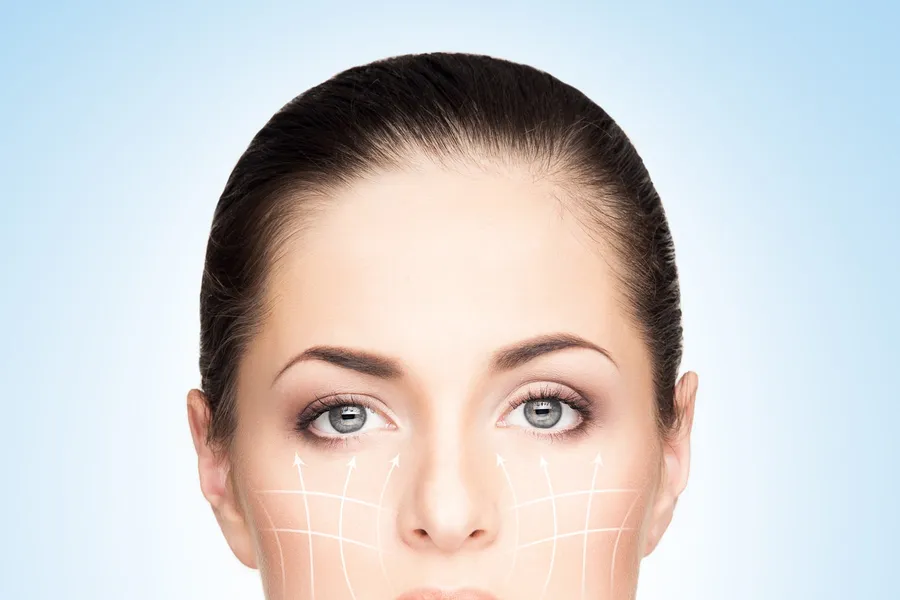
A direct lift is a surgical tightening procedure in which skin and, where required, the soft tissue beneath it are corrected directly at the lax region. The approach is deliberately placed close to the treatment area so that the elevation can be controlled very precisely. The term does not describe one single procedure for every facial region: the actual operation depends on which tissue has descended, where the excess skin lies and which scar is medically and aesthetically acceptable for the desired result.
Direct lift in Berlin – the key facts at a glance
- Treatment
- Direct surgical lift with targeted tissue excision
- Typical search terms
- Direct lift, direct brow lift, surgical brow lift
- Aim
- Correcting genuine tissue laxity directly instead of only supporting it indirectly
- Brow region
- The incision can be planned directly above the eyebrow
- Lower face / jaw
- A direct incision can only be planned after individual examination and scar assessment
- Duration of surgery
- Approx. 60–90 minutes, depending on the extent
- Anaesthesia
- Determined individually
- Downtime
- Depends on region and extent; swelling, bruising and a visible scar phase must be planned for
- Result
- Develops over weeks; scar maturation takes several months
- Location
- AS Clinic, Kurfürstendamm 102, 10711 Berlin-Charlottenburg
Direct brow lift
In a direct brow lift, a narrow, individually planned strip of skin and soft tissue is removed immediately above the eyebrow. This allows the position of the brow to be raised very precisely and separately on each side. The method can be of particular interest where genuine brow ptosis — a descended eyebrow — is present and especially direct control over height and shape is wanted or medically sensible. Assessed before surgery, among other things:
- Position of the eyebrows at rest
- Differences between the sides and asymmetries
- Excess skin on the upper lid
- Thickness and density of the eyebrow hair
- Forehead activity and unconscious raising of the brows
- Previous lid or brow surgery
- Willingness to accept a scar directly above the brow
More on this: Surgical treatments in Berlin
Brow ptosis or hooded lid – why the distinction matters
A descended eyebrow and excess upper-lid skin can look similar, but they are not the same thing. With brow ptosis the brow itself sits lower; with a hooded lid it is primarily excess lid skin that dominates. If only an upper blepharoplasty is performed although a substantial part of the finding is caused by a descended brow, the result can fall short of expectations. Conversely, not everyone with upper-lid skin automatically needs a brow lift. Brow position and upper lid are therefore assessed together before deciding whether a direct brow lift, eyelid surgery, a combination or another procedure makes more sense.
More on this: Eyelid surgery in Berlin — upper and lower blepharoplasty
Direct lift in the lower face and along the jaw region
Where tissue laxity in the lower face is pronounced, a direct surgical approach can be discussed in selected cases. The exact incision, the amount of tissue removed and the suitability cannot be described in general terms and must be planned individually. The decisive point is the scar trade-off: a direct approach lies closer to the region to be lifted. That allows a targeted correction, but it also means the resulting scar is not hidden by a distant hairline. Examined particularly closely beforehand:
- Exactly where the tissue laxity lies
- How pronounced the excess skin is
- Which natural fold or contour could absorb a possible scar
- Whether a classic facelift, neck lift or another procedure could place the scar more favourably
- How realistic the desired change is with a limited direct approach
When might filler or thread lifting not be enough?
Filler can add volume and threads can support tissue mechanically to a limited degree. Neither removes excess skin, however. Where genuine skin and tissue laxity is the main problem, surgical tightening can treat the cause more directly. That does not mean surgery is automatically the better choice — what matters is the problem to be treated.
- Volume loss without marked excess skin: a filler concept may be more relevant
- A movement-related cause: botulinum toxin treats muscle activity, not excess skin
- Slight tissue descent: minimally invasive options can be discussed
- Pronounced genuine laxity: a surgical approach can be the structurally more appropriate option
More on this: Cheek filler in Berlin — volume rather than skin excessBotox in Berlin — treating muscle activity
Direct lift or thread lifting – what is the difference?
A direct lift removes or repositions tissue surgically. A thread lift works via inserted threads and does not change excess skin in the same way. The two therefore differ markedly in invasiveness, scarring, recovery time and the strength of correction possible.
| Direct lift | Thread lifting |
|---|---|
| Surgical procedure | Minimally invasive procedure |
| Excess tissue can be removed directly | No direct skin excision |
| Precise tissue elevation via a surgical approach | Mechanical support via threads |
| A scar is unavoidable | Small puncture or access points |
| Longer healing and scar maturation phase | Usually a shorter visible recovery phase |
Direct brow lift or endoscopic / temporal brow lift?
The direct brow lift places the scar immediately above the eyebrow and thereby allows very precise local elevation. Indirect techniques often move the approach towards the hairline or temple, but involve a different surgical dissection. Which method suits better depends on hairline, forehead shape, brow position, the extent of the ptosis, the desired change, scar preference and any accompanying procedures. The direct approach is therefore not automatically the most modern or the best method for everyone. Its particular advantage is direct control; its most important trade-off is the scar close to the brow.
How visible is the scar after a direct lift?
A direct lift inevitably creates a surgical scar. In a direct brow lift it lies immediately above the brow hairs. It can fade considerably over time, but — depending on skin type, healing, hair distribution and incision position — it can remain visible. The scar is therefore not a side detail but a central part of the decision for or against the procedure. Discussed before the procedure, among other things:
- Individual tendency towards conspicuous scarring
- Density and shape of the eyebrow, and hair coverage
- Position and length of the planned incision line
- Smoking and other wound-healing factors
- The need for consistent sun protection during scar maturation
How is a natural result achieved?
A natural direct-lift result does not depend on maximum tightening. What matters is controlled tissue removal, a suitable height and shape, preservation of your individual anatomy and realistic scar planning. With a brow lift the natural brow shape should be preserved: raising it too far, or too uniformly, can change the facial expression and look unnatural. The same principle applies in the lower face — a direct procedure should correct only as much as a harmonious contour requires.
Direct lift for women and men
A direct lift can in principle be considered for both women and men. Suitability depends more strongly on anatomy, excess skin, hair distribution and scar acceptance than on gender alone. With a direct brow lift, a dense brow can integrate the scar more favourably. With very fine or heavily plucked brows, on the other hand, a scar can more easily remain visible.
How a direct lift works at AS Clinic Berlin
-
Surgical consultation
We first establish which region has actually descended or become lax, what change you want and whether a direct surgical approach makes sense compared with other procedures. Previous operations, illnesses, medication, scarring tendency and expectations are discussed.
-
Analysis at rest and in movement
In the brow region the position of the eyebrows is assessed with the forehead relaxed, because some people unconsciously raise a descended brow through constant forehead activity. In the lower face, excess skin, tissue weight and contour are assessed from several perspectives.
-
Incision and scar planning
Before surgery we mark exactly how much skin or tissue is to be removed and where the later scar will lie. The scar position is an essential part of the consent process and of the decision to operate.
-
Anaesthesia
Which form of anaesthesia is suitable is determined individually according to region, the extent of surgery and your general health.
-
Direct tissue excision and elevation
The marked tissue is removed or repositioned in a controlled way. In a direct brow lift, the approach immediately above the brow allows precise control of the elevation and the shape.
-
Wound closure and aftercare
The wound is closed carefully. In the early healing phase, cooling, rest, wound protection and the planned review appointments are the priority. The further course is assessed until wound healing and scar maturation are stable.
How does healing progress after a direct lift?
In the first few days, swelling, bruising, a feeling of tightness and a clearly visible fresh scar are normal. The swelling usually subsides gradually; the scar changes over several months and only becomes softer and paler with time. Judging the result after a few days is therefore not meaningful. Depending on the region, the socially presentable recovery time can be roughly one to several weeks. The precise recommendation depends on the extent of surgery, swelling, scar position and your individual healing.
When can I work or exercise again?
Returning to everyday life depends on the surgical region and your occupational demands. Sedentary work can be possible sooner than physically heavy work; intensive sport should be avoided during the early wound-healing phase. Your individual timetable is set out as part of the aftercare. It is particularly important to avoid tension, pressure, friction and strong increases in blood flow at the fresh surgical region.
When will I see the result?
The tissue elevation is present immediately after surgery, but is initially masked by swelling and the wound reaction. The contour becomes increasingly assessable over several weeks; the final scar quality develops over months.
How long does a direct lift last?
A direct lift removes or repositions tissue surgically and is therefore not comparable with a temporary filler or thread treatment. The natural ageing process of skin and soft tissue continues, however, so the face also changes over the years after surgery. A fixed guarantee of durability would not be serious.
Risks and possible complications
A direct lift is a surgical procedure and is not free of risk. Alongside the general risks of surgery, scar quality, asymmetry, changes in sensation and — depending on the region — injury to neighbouring nerves or hair follicles are particularly relevant. Possible risks include:
- Swelling and bruising
- Post-operative bleeding or haematoma
- Infection
- Delayed wound healing
- Conspicuous, wide or thickened scars
- Asymmetry or under- / overcorrection
- Temporary or persistent numbness or changes in sensation
- Injury to small sensory nerves
- In the brow region: possible damage to hair follicles or local hair loss
- With deeper dissection: rarely, involvement of motor nerve structures
- The need for a corrective procedure
Which symptoms should be checked after surgery?
Severe or rapidly increasing pain, markedly one-sided increasing swelling, persistent bleeding, fever, pus, pronounced skin discolouration or new, clear movement disorders should be assessed medically without delay.
Who might a direct lift be suitable for?
A direct lift can be an option for adults with a clearly defined tissue descent or excess skin, where a direct surgical approach makes anatomical sense. Particularly important is the willingness to include the resulting scar consciously in the decision. Taken into account when assessing suitability:
- Extent and location of the tissue laxity
- Skin quality and tendency to scar
- Brow shape and hair distribution in the incision area
- Previous operations or scars
- Smoking and wound-healing risks
- Pre-existing conditions and medication
- Realistic expectations of the strength of correction and the scar position
When might a direct lift not be the right treatment?
If the desired change is caused mainly by volume loss, muscle activity or only very slight tissue descent, another approach can make more sense. Anyone who would fundamentally not accept a visible scar in the treated region may also not be suitable for a direct lift. With acute infections, certain illnesses, insufficiently controlled medical risks or unfavourable wound-healing conditions, surgery can be postponed or ruled out. Prescribed medication must never be stopped or paused on your own initiative for an aesthetic procedure.
Direct lift on Kurfürstendamm in Berlin-Charlottenburg
AS Clinic Berlin is located on Kurfürstendamm in Berlin-Charlottenburg. If you are looking for a direct lift in Berlin, a direct brow lift or surgical tightening for clear tissue laxity, the first step is to assess which anatomical problem is actually present and which surgical method makes sense for it. AS Clinic Berlin, Kurfürstendamm 102, 10711 Berlin-Charlottenburg. Phone: +49 179 390 2489. Opening hours: Monday–Friday 10:00–19:00, Saturday 10:00–16:00, Sunday closed.
AS ClinicKurfürstendamm 102
10711 Berlin · Charlottenburg
+49 179 390 2489
Mon – Fri · 10:00 – 19:00
Saturday · 10:00 – 16:00
Sunday · Closed
More on this: AS Clinic Berlin on Kurfürstendamm — location and directions
Why choose AS Clinic for a direct lift in Berlin?
Treating the cause rather than masking it
Where genuine tissue laxity is the priority, we examine whether a direct surgical correction makes more sense than additional volume or temporary mechanical support.
The scar position discussed openly beforehand
The most important trade-off of a direct lift is the scar. The incision position is therefore not treated as a side issue but included in the decision before surgery.
Brow position and upper lid assessed together
A descended brow can accentuate a hooded lid. In the brow region we therefore check whether a direct brow lift, eyelid surgery, a combination or another procedure fits the actual finding.
No maximum tightening at any price
The tissue excision is planned so that a natural expression and functionally safe healing come first. A stronger lift is not automatically a better result.
Medical qualification
Nader Farahwaschy – specialist in surgery. Medical licence since 2004; specialist recognition in surgery from the Berlin Medical Association since 2011. Individual surgical suitability is assessed at the personal consultation.
Questions
Frequently asked questions about direct lift in Berlin
Twenty answers written by our physicians.
What is a direct lift?
What is a direct brow lift?
Who is a direct brow lift suitable for?
Is a direct lift the same as a facelift?
What is the difference between a direct lift and thread lifting?
What is the difference between a direct lift and filler?
Can a direct lift replace a thread lift?
Can a direct brow lift improve hooded lids?
What is the difference between brow ptosis and a hooded lid?
How long does a direct lift take?
Which anaesthesia is used?
Does a direct lift hurt?
How visible is the scar after a direct brow lift?
Can the scar be avoided completely?
How long does scar healing take?
When will I be presentable again?
When can I exercise again?
Can a direct lift correct asymmetric eyebrows?
Is a direct brow lift suitable for men?
Is a direct brow lift suitable for women?
Can a direct lift be combined with eyelid surgery?
How long does the result last?
What are the risks of a direct brow lift?
Can sensation on the forehead be changed?
When should a direct lift not be performed?
What does a direct lift cost at AS Clinic Berlin?
Where can I have a direct lift in Berlin?
Related treatments at AS Clinic Berlin
Eyelid Surgery
Eyelid surgery in Berlin: upper and lower blepharoplasty for excess lid skin.
Botox
Botox in Berlin: treats muscle activity, not excess skin.
Cheeks Filler
Cheek filler in Berlin: volume for the midface rather than skin excision.
8 Point Lift Filler
8-point lift in Berlin: a non-surgical filler concept for the facial frame.
Eyebrow Transplant
Eyebrow transplant in Berlin: density and shape, not brow position.
Skin Booster
Skin booster in Berlin: injectable hydration for skin quality.
Appointments
Surgical consultation for direct lift in Berlin
Do you have a descended brow position or clearly pronounced tissue laxity and want to know whether a direct surgical lift makes more sense than filler, threads or another surgical method? Arrange a personal consultation at AS Clinic Berlin on Kurfürstendamm. Together we assess the cause of the tissue descent, a possible incision, the scar position, alternatives, recovery time and your individual risks.